As individuals, we are visible and vulnerable. An antelope in the middle of the savannah, surrounded by a group of lions, has little chance of survival. A large herd of antelopes, by contrast, offers the possibility of hiding. In a crowd, we become an anonymous texture. But is this also right, and still necessary, in human society? We have shifted our attention strongly toward the individual, toward their needs, identity, and the illusion of happiness. Authoritarian regimes, however, still view their citizens as a mass. Perhaps, due to current trends in the democratic part of the world, we will experience a similar reversal.
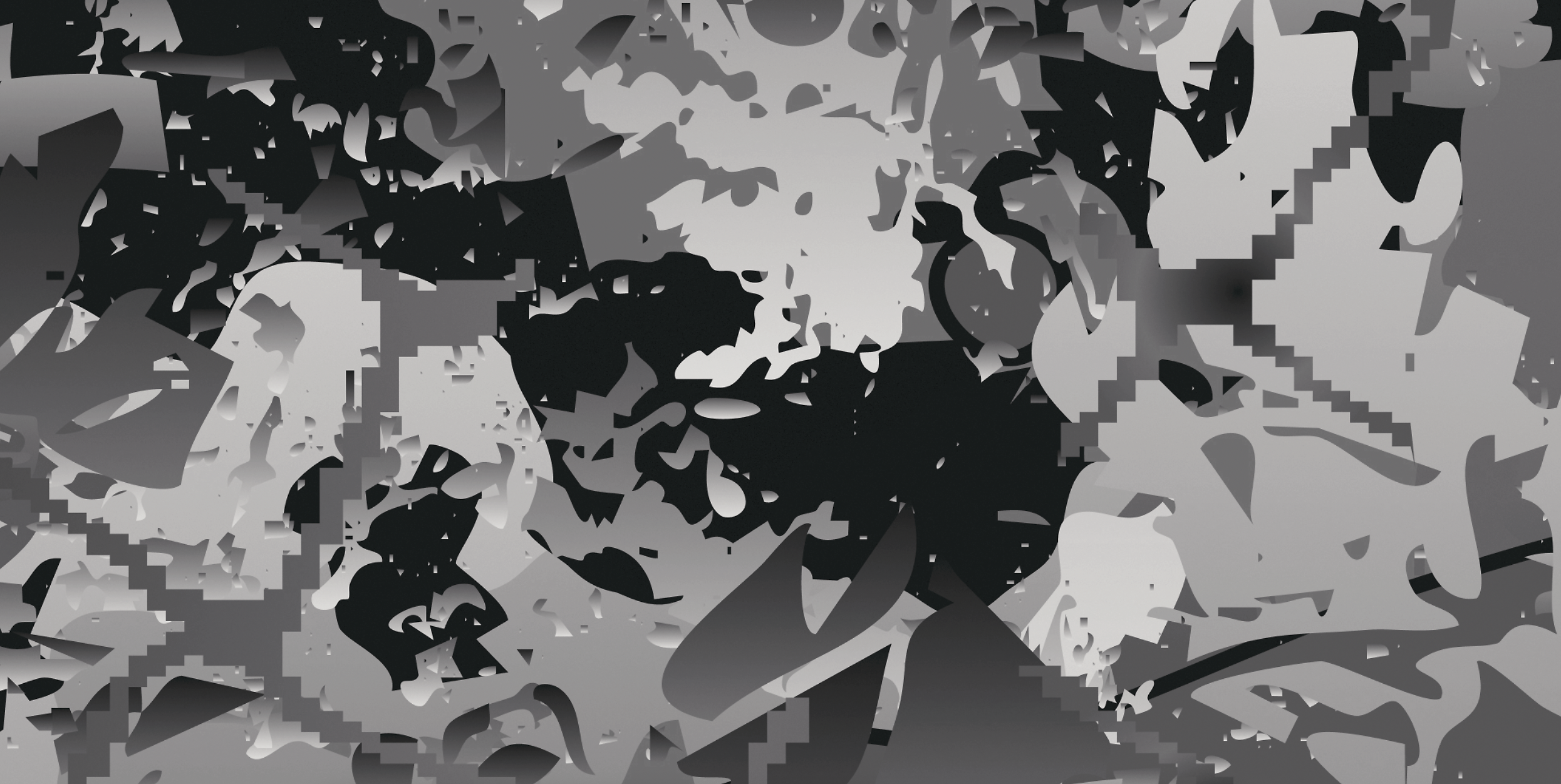
The video installation Mimicry responds to the number of people present and gradually reveals to viewers a complex camouflage pattern, moving from the individual to an anonymous mass.
Camouflage is a phenomenon that is fundamentally important in the animal world. In human society, its more significant development dates to the turn of the 19th and 20th centuries. The main reasons were handheld firearms with longer range, aerial reconnaissance, and, overall, a greater need to remain hidden. The word “camouflage” comes from the name used for the artists who worked on painting the first patterns, so-called “camoufleurs” (to disguise, to make up). The “Section de Camouflage” was the first military unit composed of artists, sculptors, and painters.
Camouflage is about form, structure, deconstruction, and breaking up an outer shape. Visually, it draws on mechanisms used in nature for millennia. It applies principles such as “countershading” and “shadow elimination.” Shape deconstruction (disruption) can also be demonstrably linked to the artistic movement of Cubism, which broke the unified form of an object into individual fragments. In nature and in the military, camouflage’s primary task is to prevent a clear outline and identification of the one who is hiding.
Visitors to the installation Mimicry have the opportunity to metaphorically hide within a crowd and observe both the construction and deconstruction of the gradually revealed camouflage pattern. It loosely follows the realization created for the Czech project Skryt, which is currently being tested by the Active Reserve of the Czech Army.
Autor: Adam Uchytil
Touch Designer, coding: Nicol Budínová
Lettering: Vojtěch Benc
Production: Karim Tarakji


The exhibition is part of the Design Ústí festival.
The exhibition Mimikry is part of the RUR Strategic Project implemented by the University of Jan Evangelista Purkyně in Ústí nad Labem, which received support from the Fair Transition Fund, CZ.10.02.01/00/22_002/0000210.